

From Formulation to Film: POTOP Accelerates PFA Film Localization
I. PFA Fluoropolymer Film: A Melt-Processable Perfluorinated Film
PFA fluoropolymer film is a melt-processable perfluoroalkoxy (PFA) copolymer film —
a high-performance thermoplastic fluoropolymer, not a general-purpose packaging film. Copolymerized from tetrafluoroethylene (TFE) and perfluoroalkyl vinyl ether (PFAVE), it retains the chemical
resistance, high-temperature resistance and low surface energy of polytetrafluoroethylene (PTFE), while being formable through thermoplastic processes such as extrusion and casting.
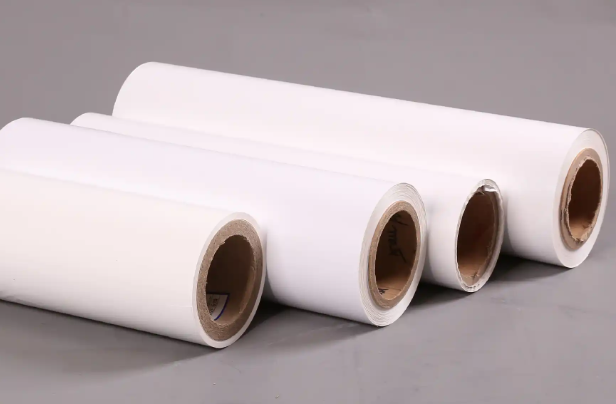
Its typical characteristics include resistance to strong acids and alkalis, resistance to organic solvents, a long-term service temperature of approximately 260 °C, excellent dielectric properties, a non-stick surface and low water absorption. Depending on the grade, the melting point is typically around 300–310 °C; refer to the manufacturer's technical data sheets for specifics.
Market opportunities are concentrated in high-value-added sectors such as semiconductors, new energy, chemical anti-corrosion, and high-end electronics and electrical insulation. However, opportunities are not evenly distributed — “if you can make it, you can sell it” does not hold true in this field. Whether a product can enter the supply chain depends on grade purity, processing stability and the progress of customer validation.
Typical R&D entry scenarios fall into four categories: high-purity liner films, observation window films and wafer release films for semiconductor wet processes; anti-corrosion isolation components for electrolyzers, fuel cells and battery modules; transparent sight glasses and storage tank linings for highly corrosive chemical service; and high-temperature insulation and low-dielectric films for high-end electronics. Each scenario has different requirements for thickness, cleanliness and dielectric performance, and the process window must be calibrated item by item.
II. The Real Barrier Lies in Processing: Four Inescapable Challenges
PFA has a narrow processing window and a high melt viscosity at elevated temperatures; the screws, barrels and temperature control systems of ordinary plastic extruders cannot be applied directly.
· Corrosion resistance: At high processing temperatures, trace corrosive decomposition products may be generated. Ordinary tool steels and chrome plating are susceptible to attack; materials such as Hastelloy C-276 and Inconel 625, together with dedicated machine management, must be evaluated.
· Thermal stability: Insufficient temperature leads to poor plasticization, while excessive temperature or excessively long residence time can cause degradation, bubbles and black specks.
· Film-forming stability: Melt sagging, thickness variation, surface roughness and draw orientation require coordinated control of the screw, die, cooling, haul-off and winding systems.
· Cleanliness control: For semiconductor and medical-grade products, equipment contamination, cleaning procedures and the packaging environment must also be controlled.
Therefore, R&D requires not just “an extruder that can heat up,” but a complete process capability integrating corrosion-resistant materials, precision temperature control, stable film forming and quality inspection.
III. POTOP's New-Generation PFA Fluoropolymer Film Extrusion Casting Machine
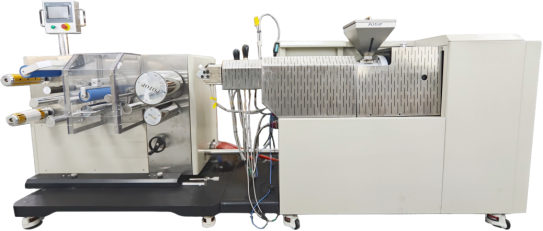
Based on systematic research into the processing characteristics of PFA, every aspect of POTOP's new-generation PFA fluoropolymer film extrusion casting machine is designed to address the challenges described above.
1. Long-Life Corrosion Resistance, Lower Consumable Costs
Hastelloy core components enable continuous, uninterrupted trial runs of ETFE, PVDF and other modified fluoropolymers, eliminating the need for frequent screw and barrel replacement — well suited to high-frequency formulation iteration at enterprises and universities.
2. Precise Process Control, Eliminating Blending and Forming Defects
Independent servo drives for each section, ±1 °C high-precision temperature control, and a custom compounding screw allow lab-scale sample data to be directly benchmarked against production lines.
3. Small-Batch, Material-Saving Trials, Doubling Formulation R&D Efficiency
The compact, integrated design requires only 3–5 kg of material per trial run, significantly reducing material costs; complete process parameter storage means comparative trials with different blending ratios require no repeated machine setup.
4. Strong Versatility, Covering the Full Range of Modified Perfluoropolymer Systems
Beyond PFA, the machine is also compatible with PVDF, FEP and other corrosion-resistant materials, completing R&D and prototyping of various anti-corrosion films on a single machine.
Equipment is only one link in R&D. Complete PFA film development also requires resin grade selection, performance testing, customer certification and a stable mass-production process. What POTOP provides is equipment and process commissioning support — it does not replace the customer's own materials R&D and quality verification.
IV. Customer Trial Run Verification: PFA + Color Masterbatch, Stable Film Formation
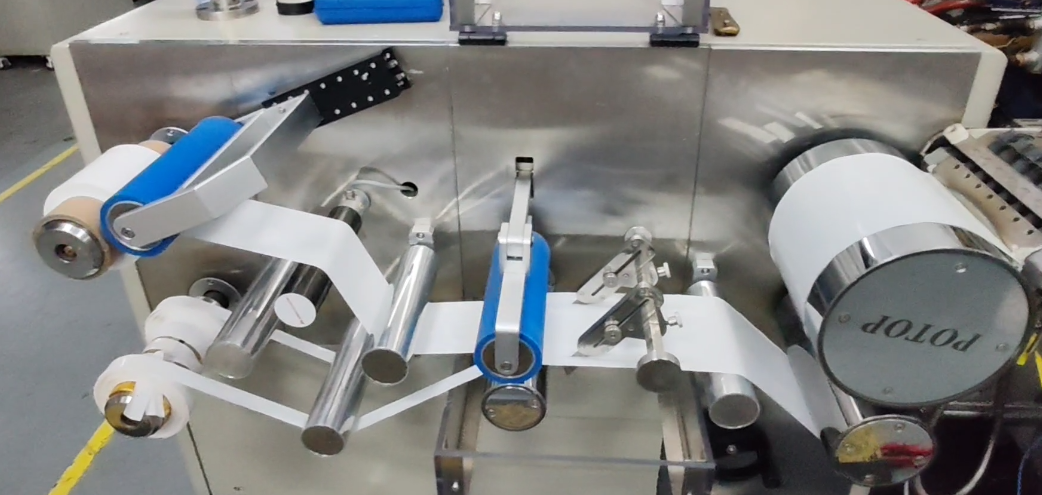
Trial material: PFA + color masterbatch; 10 kg charged; target width 80 mm; target thickness 0.20 mm; material pre-dried at 80 °C for 3 hours. Centered on the two goals of “preventing degradation” and “preventing stratification,” two groups of parameter optimizations were carried out on site.
(1) Temperature Gradient Optimization (Core Anti-Degradation Measure, Ensuring Uniform Masterbatch Dispersion)
· Segmented temperature control of barrel and die: Feeding zone 350 °C, compression zone 365 °C, multi-stage homogenizing zones held steadily at 370 °C, die end raised to 380 °C — a gentle stepwise temperature ramp matched to the high melting point of PFA; material pre-dried at 80 °C for 3 hours to effectively remove moisture and avoid bubbles and pinholes in the film. Strict zone-temperature management avoids local overheating that would trigger thermal decomposition of PFA and suppresses the generation of corrosive fluorine-containing gases; a supporting mold-temperature controller holds 260 °C constant, reducing die temperature fluctuation and stabilizing the melt state.
· Casting roll temperature optimization: The casting roll is held at a constant 260 °C for setting and temperature control, matching the crystallization window of PFA and slowly releasing internal stress during film formation; this avoids stress concentration and film warpage caused by quenching, while allowing color masterbatch particles sufficient time to flow and disperse, reducing color spots and streaks and ensuring a smooth, uniform surface on the colored PFA film.
(2) Matching Optimization of Extrusion and Casting Speeds
· Screw speed and melt pressure control: Screw speed fixed at 49 rpm to control the shear level and achieve full, uniform blending of the PFA matrix with the masterbatch; excessively high speed generates shear heat that accelerates fluororesin degradation, while excessively low speed causes masterbatch agglomeration and increased crystal points; melt pressure is steadily maintained at 3.6 MPa, giving continuous, smooth, pulse-free discharge. The die gap is set to 0.4 mm, leaving a reasonable extrusion gap that works with subsequent micro-drawing to achieve the target film thickness.
· Multi-roll stepwise speed ramp and tension management: Casting roll A at 1.3 m/min, casting roll B at 1.319 m/min, haul-off roll at 1.341 m/min — a stepwise micro-stretch speed ratio for precise draw ratio control; combined with differentiated tension settings — winding tension 35%, edge winding tension 25% — the film path is stabilized, transverse thickness uniformity is improved and winding wrinkles are suppressed.
Trial results: the machine extruded and formed film continuously and stably, with a measured thickness of 0.20 mm, a smooth and glossy film surface, and a stable width of 80 mm throughout, with no noticeable crystal points or color spots.
Breakthroughs in high-end PFA fluoropolymer film processing cannot be achieved without the support of precision forming equipment. From formulation screening and temperature gradient commissioning to multi-stage haul-off tension matching, POTOP's corrosion-resistant extrusion casting machine — with its anti-corrosion hardware and precision control capabilities — provides a stable validation platform for the R&D of colored and modified PFA and high-purity PFA films. We will continue to help fluoromaterial companies overcome forming challenges, accelerate the localization of perfluorinated functional films, and break through together in the semiconductor, new energy and advanced composite materials arenas.
From a laboratory formulation to a specialty film recognized by customers, the equipment must withstand corrosion — and, more importantly, keep every trial run stable.
Data note: The above is a record of a single trial run under a specific formulation and operating conditions, and does not represent the forming results of other grades and specifications; mass production still requires equipment validation, process confirmation and quality acceptance according to the customer's own specifications.


