

The Big Family of Fluoroplastics: What Are the Major Fluororesins?
Fluoroplastics are a class of thermoplastic resins with fluorine atoms on the polymer backbone.
Seven major types dominate the market, while a small number of specialty amorphous fluororesins are deployed for optics and
high-end coatings.
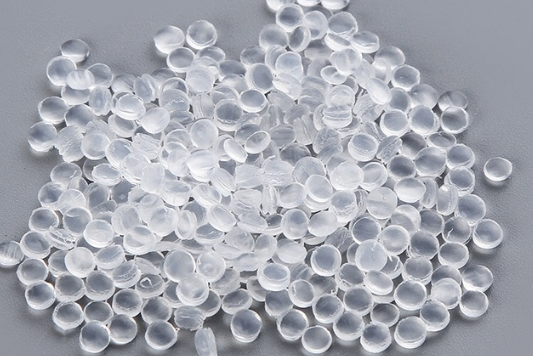
PTFE (Polytetrafluoroethylene):
The well-known Teflon. It features an exceptionally stable molecular structure, setting the benchmark among fluoromaterials for temperature and chemical resistance. Its defining trait: it cannot be melt-processed and cannot be extruded or cast like conventional plastics. Films are typically made by skiving from billets to produce skived films, or by biaxial stretching to yield porous ePTFE membranes.
FEP (Fluorinated Ethylene Propylene / Perfluoroethylene Propylene Copolymer)
A modified variant of PTFE. It retains nearly PTFE-grade chemical resistance while being melt-extrudable and heat-sealable. It is the most cost-effective perfluorinated film material and the primary raw material for release films.
PFA (Perfluoroalkoxy Resin): Also melt-processable. It outperforms FEP in maximum temperature resistance, creep resistance and ultra-high purity. It suits continuous high-temperature service, semiconductors, biomedicine and other high-cleanliness applications, though it comes at a higher price.
ETFE (Ethylene-Tetrafluoroethylene Copolymer) Transparent, highly tough, with high tensile strength and radiation resistance, plus outstanding light transmittance. It can be welded and thermoformed, making it a standout material for architectural membrane structures and front sheets of flexible photovoltaics.
PVDF (Polyvinylidene Fluoride): Relatively cost-efficient, weather-resistant and UV-stable, with piezoelectric properties. It is widely used in photovoltaic backsheets, lithium batteries, piezoelectric sensing membranes, and water treatment membranes.
ECTFE (Ethylene-Chlorotrifluoroethylene Copolymer): High rigidity, wear-resistant and resistant to strong alkalis. It is commonly fabricated into thick sheets and linings for corrosion-resistant liners on chemical processing equipment.
PCTFE (Polychlorotrifluoroethylene): Offers excellent water vapor barrier performance and superior low-temperature properties. It is mainly used for pharmaceutical packaging, high-barrier thin films and low-temperature seals.
Among these, fluoroplastic films and sheets represent one of the most representative forms of fluoroplastic applications. Compared with ordinary plastic films, they operate reliably under harsher thermal, chemical and electrical conditions, earning them the reputation as “invisible critical materials” in high-end manufacturing. Niche specialty fluororesins such as THV, Teflon AF and CYTOP are used primarily for optical films, low-refractive-index coatings, optical fibers and premium seals, with relatively low production volumes.
Which Industries Use Fluoroplastic Films?
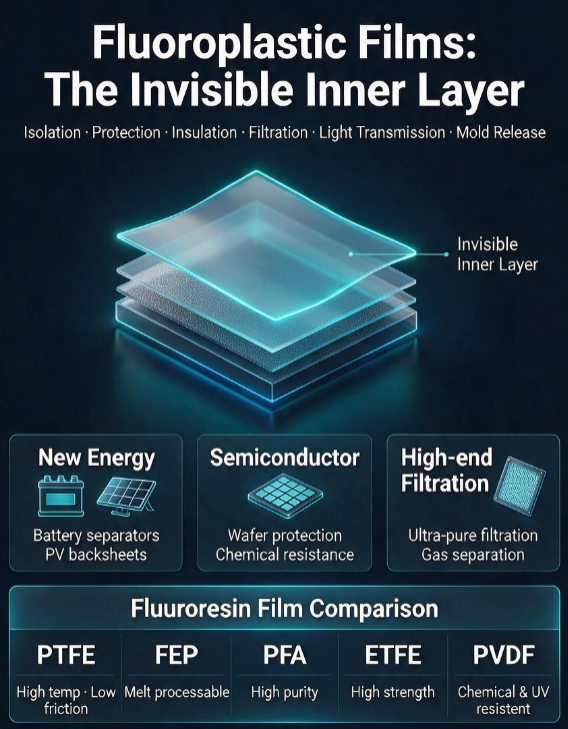
The value of fluorofilms lies in their ability to operate stably and long-term in harsh environments where conventional plastics, rubbers and metals fail. Their applications span nearly all segments of high-end manufacturing.
Electronics, Electrical Engineering and Semiconductors
Fluoroplastic films deliver excellent electrical insulation and low dielectric loss, ideal for high-frequency circuits, flexible printed circuits, capacitor dielectrics, cable insulation and similar uses. In the semiconductor industry, high-purity PFA, PTFE and FEP films and sheets are widely adopted in wet processing equipment, chemical delivery systems, viewports and other components.
New Energy
In photovoltaics, fluoroplastic films serve as backsheets, encapsulants and weather-resistant protective layers. Materials including PVDF, FEP and ETFE are indispensable in photovoltaic modules owing to their UV resistance, weatherability, light transmission or reflective characteristics. For lithium batteries, PVDF is commonly used for separator coatings, electrode binders and related functional films. As new-energy materials demand higher safety, durability and lightweighting, the application value of fluoroplastic films keeps rising.
Chemical Corrosion Protection and Industrial Manufacturing
Chemical equipment regularly contacts corrosive media such as acids, alkalis and solvents, which readily degrade, swell or damage ordinary materials. Fluoroplastic films and sheets function as liners, seals, isolation layers or transparent viewports to maintain stable equipment operation under demanding working conditions. They also play a vital role in roller covering, release lining, gaskets, filtration and separation processes.
Construction and Agriculture
ETFE films feature high transparency, low weight and excellent weather resistance, and are used for inflatable architectural membrane structures, greenhouse
covering films and daylighting roofs. Compared with traditional glass, ETFE membrane structures are lighter, transmit light well and offer good impact resistance.
Medical and Packaging
Fluoroplastic films possess favourable biocompatibility, cleanliness and barrier properties, suitable for medical breathable membranes, sterile packaging and pharmaceutical barrier packaging. Some ultra-high-purity fluoroplastic films are also used in high-cleanliness medical devices and laboratory consumables.
Fluoroplastic films are just an invisible layer hidden inside products, yet they perform critical functions including isolation, protection, insulation, filtration, light transmission and release. Driven by the continuous growth of the new energy, semiconductor and high-end filtration industries, demand for fluorofilms keeps rising.
For film manufacturers, material purchasers and engineers, an understanding of the processing limits, temperature resistance, barrier properties and heat-sealing characteristics of different fluororesins is essential. Only in this way can the most suitable film material be selected according to service conditions, preventing product failure and unnecessary cost waste caused by improper material choice.


